
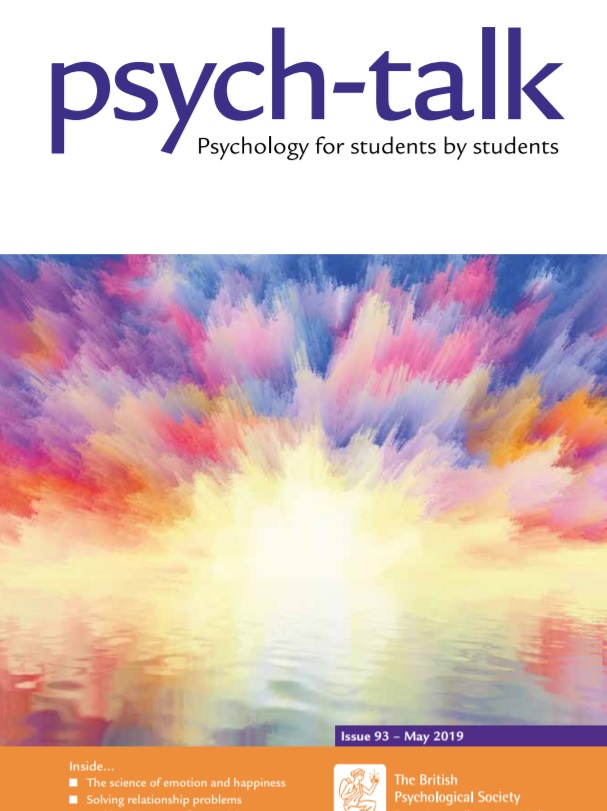
Please note this is the pre-publication manuscript to the article that has been published in the BPS Psych-Talk magazine (also the formatting is not quite right but I’m not sure how to format it properly on here):
Evangelou, G. (2019). How much do we really know about the science of emotion and happiness?. BPS Psych-Talk, 93, 3-4.
Link: https://shop.bps.org.uk/publications/publication-by-series/psych-talk/psychtalk-issue-93-may-2019.html
How much do we really know about the science of emotion and happiness?
Emotion
In terms of what an emotion is and the reasons/functions of it is largely debated, from the Darwinian perspective right across to the social constructivist. This debate may even remain so until the end of time and can be left to philosophers. Science is there to identify the properties and effects of phenomena, and under what conditions they are caused by (Edelman & Tononi, 2013). There are discrepancies about the universality of Ekman’s basic emotional expressions, and emotional language (i.e. fear, anger) due to untranslatable words which leaves this also still up for debate. What science has managed to do is reduce emotion to its raw state via natural semantic metalanguage (Wierzbicka, 2009), attempting to define cognitive scenarios through universal human concepts. Additionally, what can be objectively identified as emotion is an affective system (Blanchette & Richards, 2010) in which we subjectively experience positive and negative states. These states interact with and influence cognition, including higher level cognitive processes such as reasoning, judgement and decision making.
Further complexity arises in determining the conditions in which emotions take place and how they affect behaviour. Coulson (2004) proposed six independent basic contexts in which emotions may arise: event, agent, embodied, interpersonal, topographical and historical. Interactions of these then influence behaviour. Catastrophe theory (Zeeman, 1976) considers time: how and when these conditions become apparent will determine the directional cause of behaviour. Science has made apparent the central role emotion has in our cognition and behaviour. It has also attempted and been somewhat successful in predicting how and under what conditions we may feel these affective states, thus what may have plausibly caused behaviour. This has provided sophisticated insight into the cognitive biases we are subject to, as well as affect influenced behaviour. Therefore, science has thus far granted us, at the very least, a basic emotion manual for self-regulation and interpersonal relations.
Happiness
Happiness is largely measured via subjective self-reporting so can be argued not much to be taught from science. However, clever experimental methods with observable measures have presented evidence for ways to augment happiness. For example, photo-taking during experiences demonstrated an increase in engagement by not only self-report but also looking at how many photos were taken and analysing eye-tracking data (Diehl, Zauberman & Barasch, 2016). This mediation leads to increased enjoyment for typically unengaging events and decreased enjoyment if the event is already engaging or if it triggers negative affect. This idea of engagement is further supported when studying money and happiness—buy more experiences rather than material goods (Dunn, Gilbert & Wilson 2011). In their theory of how to spend money to make you happy, there are links between other supportive empirical evidence in positive psychology. Firstly, using money to benefit others is supported by evidence for good relationships as a necessary condition for high happiness (Diener & Seligman, 2002). Secondly, buy more small pleasures and fewer large, again supported by Diener and Seligman (2002) as very happy people experience more stable frequent moderate emotions rather than euphoric states. Lastly, delay consumption which is evident in the classic habituation wheel whereby adapting to experiences causes a decrease in pleasure.
Seligman’s PERMA model has also provided a measure in which you can get an understanding of where you most gain subjective happiness from: Pleasure, engagement, relationships, meaning or achievement. If you determine this in order of highest to lowest, this indicates a good way to allocate your time and effort when attempting to achieve happiness. It can be concluded that science, at the very least, has presented evidence for basic ways which may increase enjoyment; as well as the all-important use of your finances. Furthermore, if met halfway by the individual by gaining self-insight, science has provided a direction for where to allocate time and resources to increase happiness.
Author
George Evangelou, Middlesex University (Music, cognition and communication lab) and Goldsmiths MSc + PhD candidate. Email: george.evangelou@outlook.com
References
Blanchette, I., & Richards, A. (2010). The influence of affect on higher level cognition: A review of research on interpretation, judgement, decision making and reasoning. Cognition & Emotion, 24(4), 561-595.
Coulson, M. (2004). An ‘Everything But’Framework for Modeling Emotion. In Proc, AAAI Spring Symposium on” Architectures for Emotion.
Diehl, K., Zauberman, G., & Barasch, A. (2016). How taking photos increases enjoyment of experiences. Journal of personality and social psychology, 111(2), 119.
Diener, E., & Seligman, M. E. (2002). Very happy people. Psychological science, 13(1), 81-84.
Edelman, G. M., & Tononi, G. (2013). Consciousness: How matter becomes imagination. Penguin UK.
Dunn, E. W., Gilbert, D. T., & Wilson, T. D. (2011). If money doesn’t make you happy, then you probably aren’t spending it right. Journal of Consumer Psychology, 21(2), 115-125.
Wierzbicka, A. (2009). Language and metalanguage: Key issues in emotion research. Emotion review, 1(1), 3-14.
Zeeman, E. C. (1976). Catastrophe theory. Scientific American, 234(4), 65-83.
 The Theory of Anything
Leave a comment